
Your blog post is ranking on page one of Google. You spent weeks on it: the keyword research, the backlinks, the perfect meta description. But when your potential customer asked ChatGPT, “Which digital marketing agency should I hire in Gurgaon?” your name didn’t come up. Not even once.
That’s not a traffic problem. That’s a visibility problem, and it’s exactly why 2026 is forcing every business to have a conversation they’ve been avoiding: AEO vs. SEO. Which one actually wins leads? The honest answer isn’t one or the other. But one of them is quietly eating the other’s lunch, and if you’re not paying attention, you’ll feel it in your pipeline before you ever notice it in your analytics.
First, Let’s Be Honest About What Each One Actually Does
SEO (Search Engine Optimisation) is the discipline most businesses know. You optimise your content so Google’s algorithm ranks it higher in search results. Someone types “digital marketing agency Gurgaon” → Google shows ten links → they (hopefully) click yours. It’s a click game. Always has been.
AEO (Answer Engine Optimisation) is a different beast entirely. It optimises your content so AI platforms think ChatGPT, Perplexity, Google’s AI Overview, and Gemini can extract, trust, and cite your content when someone asks a direct question. No ranking page. No ten blue links. Just an answer. And either your business is part of that answer, or it isn’t.
Here’s the shift that makes this matter: search behaviour has changed more in the last 18 months than in the previous 18 years. People no longer want a list of results. They want the result. And AI is giving it to them.
The Lead Quality Question And Why AEO Wins It
This is where the real conversation begins, because most AEO vs. SEO articles talk about traffic. Traffic is vanity. Leads are the point.
Consider this: the average query length in traditional search is 3.37 words. In contrast, the average prompt length in ChatGPT is 23 words, with some prompts reaching up to 2,717 words. Read that again. When someone types into Google, they’re browsing. When someone types into an AI engine, they’re deciding.
That difference in intent is everything. A person who asks ChatGPT, “I run a D2C brand with ₹40 lakh monthly revenue, and I need a performance marketing agency that understands Meta ads and influencer integration. Who should I hire?” is not window shopping. They’re a week away from signing a contract. Traffic from AI engines ends up being much more qualified. At HubSpot, they observed 3x better lead conversion coming from AEO than other sources. Three times. That’s not a marginal improvement; that’s a different category of result.
Where SEO Still Holds Its Ground
Google holds close to 90% of the market, and that isn’t changing any time soon. SEO is still the bedrock of digital visibility. It drives discovery, builds domain authority, and feeds the very thing AEO depends on: a credible, well-structured web presence. Here’s a truth nobody says loudly enough: there is no AEO without SEO. Without strong SEO, there is no AEO, because AI cannot “read” what it cannot find.
SEO excels at top-of-funnel awareness. When someone is still exploring, comparing options, learning about a service category, researching before they know what they want, SEO content meets them there. Think blog posts, pillar pages, category guides. This is content that earns trust over time and builds the kind of authority that AI engines later learn to cite.
AEO should be a priority when users want clear, direct answers, while SEO becomes essential when they need depth, comparison, or evaluation. Both are true at different moments of the buyer’s journey.
The 2026 Reality Check: What the Numbers Are Saying
AI-referred sessions jumped 527% year-over-year in 2025. That’s not growth, that’s a category explosion. Meanwhile, Gartner predicted that search engine volume would drop by 25% as users migrate to AI chatbots. When an AI engine gives a full, comprehensive answer, users have no reason to click through to your blog.
This creates a brutal paradox for businesses still playing the old game: you could rank #1 on Google and still be invisible to the buyer who made their decision on Perplexity at 11 pm. Many businesses may still rank well yet gradually lose influence without realising it.
And yet, 70% of marketers believe AEO would significantly impact their strategy in 2026, yet only 20% have actually started implementing it. That gap between knowing and doing? That’s your competitive window, and it won’t stay open long.
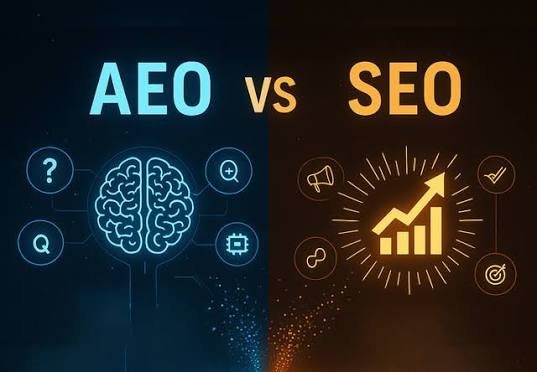
AEO vs. SEO: The Side-by-Side That Actually Helps You Decide
| Aspect | SEO (Search Engine Optimization) | AEO (Answer Engine Optimization) |
| Goal | Rank on search engine results pages (SERPs) | Be cited and referenced in AI-generated answers |
| Traffic Type | Volume-driven and broad audience traffic | Intent-driven and highly qualified traffic |
| Buyer Stage | Awareness to consideration | Consideration to decision |
| Lead Quality | Variable and depends on search intent | Generally higher due to stronger purchase intent |
| Content Style | Long-form, keyword-focused, and comprehensive | Structured, concise, accurate, and question-answer oriented |
| Measurement | Rankings, organic clicks, impressions, and sessions | AI citations, brand mentions, referral quality, and answer visibility |
| Time to Results | Typically 3–6 months | Usually 2–4 months with proper optimization |
| 2026 Trajectory | Facing declining click-through rates due to AI search experiences | Experiencing rapid growth in AI-driven referrals and visibility |
The DigiSimba Perspective: Stop Choosing, Start Stacking
At DigiSimba, we’ve watched this debate play out with clients across industries and the businesses that win aren’t the ones who chose between AEO and SEO. They’re the ones who understood that SEO provides the access (crawlability), while AEO provides the answer (synthesizability). One builds the foundation; the other builds the reputation.
The practical approach for 2026 looks like this: use SEO to ensure your content is discoverable, authoritative, and technically sound. Use AEO principles, structured data, direct question-answering formats, clear entity definition, and schema markup to ensure that once AI systems find you, they trust you enough to cite you.
The brands winning now are not the ones chasing one channel at a time. They are the ones building a system where technical SEO, content design, authority building, structured data, user experience, and entity clarity all work together.
So, Which Drives More Leads in 2026?
Here’s the straight answer: AEO wins on lead quality. SEO wins on lead volume. If your business needs more people in the funnel, double down on SEO. If your business needs the right people buyers who are already 70% decided before they ever reach you, AEO is where you invest next.
But the real winner in 2026 isn’t either discipline alone. It’s the business that stops treating them as rivals and starts running them as a single, unified visibility strategy.
The question was never AEO vs. SEO. The question is: when your ideal customer asks an AI who can solve their problem, will your name come up? DigiSimba is a Gurgaon-based digital growth studio helping brands build visibility across both traditional search and AI-driven platforms. We don’t just chase rankings, we engineer authority.